
What is your data warehouse
actually costing you?

What is your data warehouse
actually costing you?

The build is only the beginning. Licensing, cloud consumption, specialist labour, integrations, maintenance and change requests can turn a data warehouse into a long-term operating cost few businesses have properly measured.

The build is only the beginning. Licensing, cloud consumption, specialist labour, integrations, maintenance and change requests can turn a data warehouse into a long-term operating cost few businesses have properly measured.

The build is only the beginning. Licensing, cloud consumption, specialist labour, integrations, maintenance and change requests can turn a data warehouse into a long-term operating cost few businesses have properly measured.

Built 70% faster than a traditional approach

Using maadi's automated warehouse methodology.

Built 70% faster than a traditional approach

Using maadi's automated warehouse methodology.

The build has a price.
Ownership has a cost.

The build has a price.
Ownership has a cost.

A data warehouse has an obvious cost to build. The less obvious cost is everything that comes after.

Licences. Cloud consumption. Specialist skills. Integration monitoring. Maintenance. Change requests. Support.

And then there are the costs that rarely appear on a budget line: technical debt, undocumented logic, reporting workarounds and dependency on the people who know how everything works.

Over time, these costs can become a significant part of what your data foundation actually costs the business.

A data warehouse has an obvious cost to build. The less obvious cost is everything that comes after.

Licences. Cloud consumption. Specialist skills. Integration monitoring. Maintenance. Change requests. Support.

And then there are the costs that rarely appear on a budget line: technical debt, undocumented logic, reporting workarounds and dependency on the people who know how everything works.

Over time, these costs can become a significant part of what your data foundation actually costs the business.

A data warehouse has an obvious cost to build. The less obvious cost is everything that comes after.

Licences. Cloud consumption. Specialist skills. Integration monitoring. Maintenance. Change requests. Support.

And then there are the costs that rarely appear on a budget line: technical debt, undocumented logic, reporting workarounds and dependency on the people who know how everything works.

Over time, these costs can become a significant part of what your data foundation actually costs the business.

The question isn't just:

The question isn't just:

The question isn't just:

"What did we spend building it?"

"What did we spend building it?"

"What did we spend building it?"

It's:

It's:

It's:

"What will it cost us to own and change it?"

"What will it cost us to own and change it?"

"What will it cost us to own and change it?"

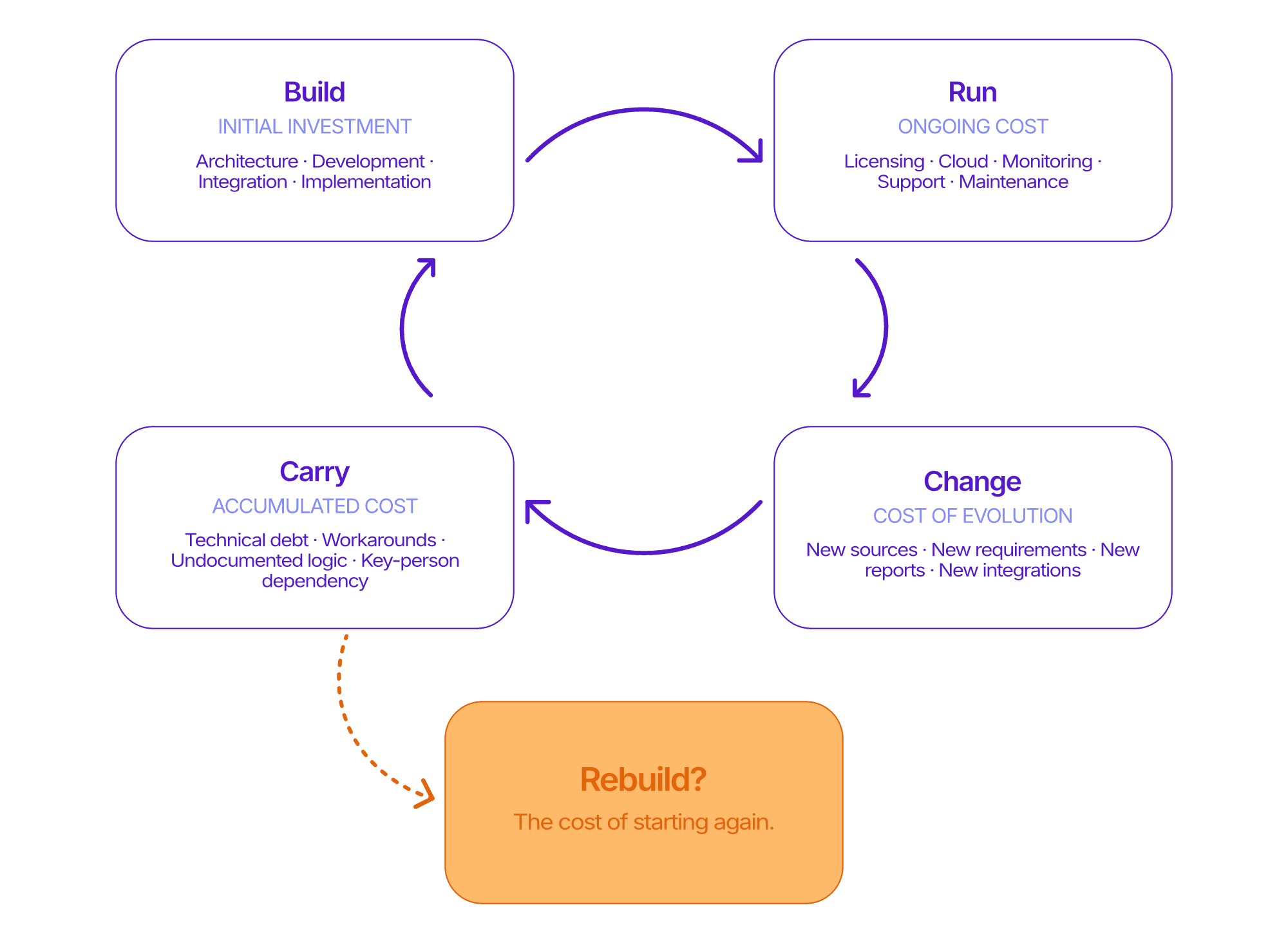
Build

Build

Architecture · Development · Integration

Architecture · Development · Integration

->

Run

Run

Licensing · Cloud · Monitoring · Support

Licensing · Cloud · Monitoring · Support

->

Change

Change

New requirements · New data · Reporting · Development

New requirements · New data · Reporting · Development

->

Carry

Carry

Technical debt · Documentation · Workarounds

· Key-person dependency

Technical debt · Documentation · Workarounds

· Key-person dependency

->

Total cost of ownership

Total cost of ownership

The build has a price.
Ownership has a cost.

A data warehouse has an obvious cost to build. The less obvious cost is everything that comes after.

Licences. Cloud consumption. Specialist skills. Integration monitoring. Maintenance. Change requests. Support.

And then there are the costs that rarely appear on a budget line: technical debt, undocumented logic, reporting workarounds and dependency on the people who know how everything works.

Over time, these costs can become a significant part of what your data foundation actually costs the business.

The question isn't just:

"What did we spend building it?"

It's:

"What will it cost us to own and change it?"

Build

Architecture · Development · Integration

->

Run

Licensing · Cloud · Monitoring · Support

->

Change

New requirements · New data · Reporting · Development

->

Carry

Technical debt · Documentation · Workarounds

· Key-person dependency

->

Total cost of ownership

The real cost sits in three places.

The real cost sits in three places.

Your warehouse doesn't just cost money to build. It costs to run, change and understand - often across different teams, budgets and suppliers.

Your warehouse doesn't just cost money to build. It costs to run, change and understand - often across different teams, budgets and suppliers.

1

1

Run

Run

Keeping the warehouse working

Keeping the warehouse working

The infrastructure doesn't maintain itself once the project is delivered.


Database & platform licensing · Cloud consumption · Integration monitoring · Maintenance · Support · Specialist operational skills

The infrastructure doesn't maintain itself once the project is delivered.


Database & platform licensing · Cloud consumption · Integration monitoring · Maintenance · Support · Specialist operational skills

"We're already paying this."

"We're already paying this."

2

2

Change

Change

Making the warehouse do something new

Making the warehouse do something new

Every new business requirement can create another piece of work - and another dependency on specialist skills.


Change requests · New data sources · New integrations · Reporting changes · Data model changes · Development & testing


The real test of a data architecture isn't whether it works on day one. It's how much effort it takes to change on day 500.

Every new business requirement can create another piece of work - and another dependency on specialist skills.


Change requests · New data sources · New integrations · Reporting changes · Data model changes · Development & testing


The real test of a data architecture isn't whether it works on day one. It's how much effort it takes to change on day 500.

"We're going to keep paying this."

"We're going to keep paying this."

2

Carry

Carry

Living with what was built

Living with what was built

Some of the biggest costs don't come with an invoice. They come from the complexity your organisation carries forward.


Technical debt · Undocumented logic · Key-person dependency · Reporting workarounds · Tribal knowledge · Manual processes


Every workaround becomes part of the architecture. Every undocumented decision becomes future work.

Some of the biggest costs don't come with an invoice. They come from the complexity your organisation carries forward.


Technical debt · Undocumented logic · Key-person dependency · Reporting workarounds · Tribal knowledge · Manual processes


Every workaround becomes part of the architecture. Every undocumented decision becomes future work.

"We're accumulating this."

"We're accumulating this."

Run + Change + Carry = The cost of ownership

Run + Change + Carry = The cost of ownership

Run + Change + Carry = The cost of ownership

The challenge is that these costs rarely sit in one place. They are spread across technology, people, projects and business teams - making the true cost difficult to see.

The challenge is that these costs rarely sit in one place. They are spread across technology, people, projects and business teams - making the true cost difficult to see.

The challenge is that these costs rarely sit in one place. They are spread across technology, people, projects and business teams - making the true cost difficult to see.

What will your data foundation cost to own - and change - over the next 510 years?

What will your data foundation cost to own - and change - over the next 510 years?

A warehouse can look cost-effective when you measure the implementation alone.

But a data foundation isn't a one-off project. It becomes part of the organisation's operating infrastructure - consuming resources, supporting new requirements and accumulating complexity over time.

The decisions you make today can determine how much it costs to run, maintain and change tomorrow.
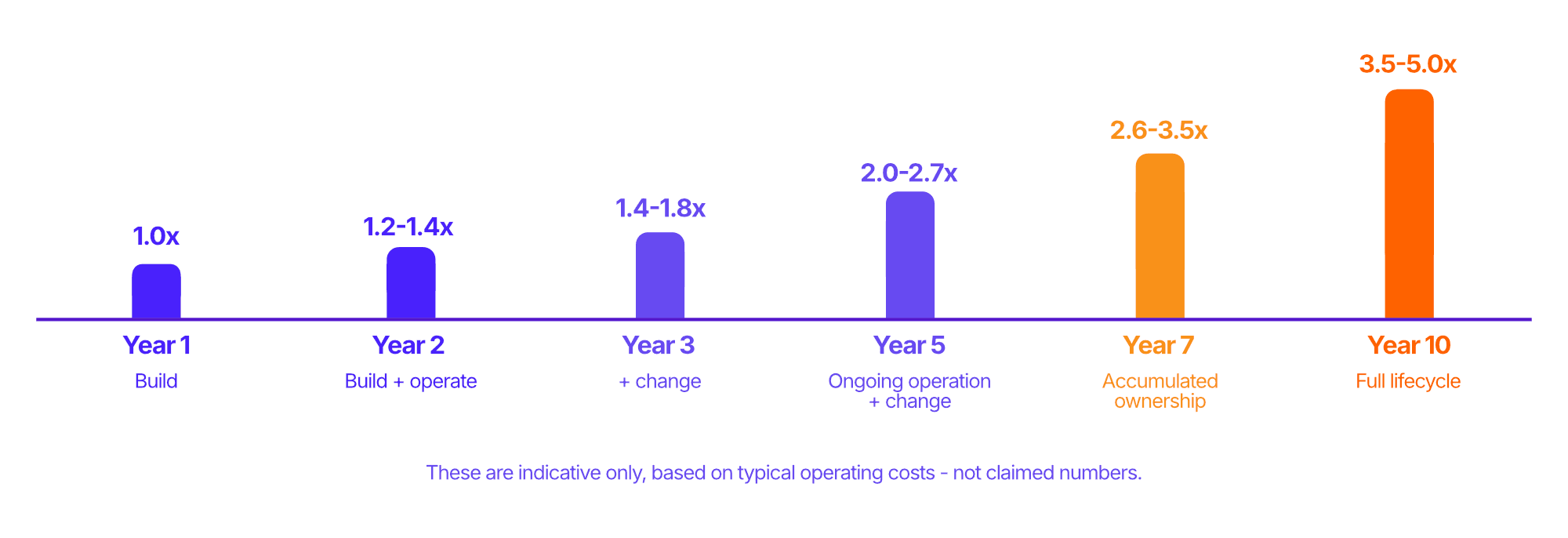
The cheapest warehouse to build isn't necessarily the cheapest warehouse to own.

The cheapest warehouse to build isn't necessarily the cheapest warehouse to own.

The cheapest warehouse to build isn't necessarily the cheapest warehouse to own.

A lower upfront cost can be quickly eroded by expensive change, specialist dependencies and years of accumulated technical debt.

That's why the right question isn't simply "What will it cost to build?" It's "What will it cost us to own?"

A lower upfront cost can be quickly eroded by expensive change, specialist dependencies and years of accumulated technical debt.

That's why the right question isn't simply "What will it cost to build?" It's "What will it cost us to own?"

Two ways to build a data foundation.

Two ways to build a data foundation.

We've looked at what a data warehouse really costs to own - not just the initial build, but the people, platforms, maintenance and ongoing change required to keep it working. How you build that foundation has a direct impact on those costs.


A traditional approach typically treats the warehouse as a project: build it, hand it over, then manage the ongoing work through internal teams, change requests and specialist suppliers.


maadi takes a different approach. The foundation is built using repeatable, automated patterns and then managed as an ongoing capability - bringing the build, operation and evolution together.


The result is two very different ownership models:

We've looked at what a data warehouse really costs to own - not just the initial build, but the people, platforms, maintenance and ongoing change required to keep it working. How you build that foundation has a direct impact on those costs.


A traditional approach typically treats the warehouse as a project: build it, hand it over, then manage the ongoing work through internal teams, change requests and specialist suppliers.


maadi takes a different approach. The foundation is built using repeatable, automated patterns and then managed as an ongoing capability - bringing the build, operation and evolution together.


The result is two very different ownership models:

Traditional approach

Build → Handover → Maintain → Change → Repeat

Build

Custom development · Data modelling · Integrations · Deployment

Operate

Internal specialists · Platform management · Monitoring · Maintenance

Change

New projects · Change requests · Additional development · Consulting

Carry

Technical debt · Documentation gaps · Workarounds · Key-person dependency

The result: the warehouse becomes another system the organisation has to continuously manage.

maadi

Build → Run → Evolve

Build

Automated development · Repeatable patterns · Rapid deployment · Documented logic

Operate

Managed infrastructure · Integration monitoring · Maintenance · Support

Change

Ongoing development · New data sources · New requirements · Continuous improvement

Carry

Governed architecture · Transparent logic · Reduced dependency · A foundation designed to evolve

The result: the data foundation becomes a managed capability - rather than another system your team has to carry.

Traditional warehouse economics

Traditional warehouse economics

Pay to build.
Pay to operate.
Pay again to change.
Carry the complexity.

Pay to build.
Pay to operate.
Pay again to change.
Carry the complexity.

maadi economics

maadi economics

Build efficiently.
Operate as a managed service.
Change on the same foundation.
Reduce the complexity you carry.

Build efficiently.
Operate as a managed service.
Change on the same foundation.
Reduce the complexity you carry.

The cost isn't just what you pay for the warehouse. It's what the warehouse requires from your business.

Less manual work. Less time to value.

Less manual work. Less time to value.

In a recent engagement, maadi delivered a data warehouse 70% faster than a traditional approach, reducing the amount of manual development required to establish the data foundation.

In a recent engagement, maadi delivered a data warehouse 70% faster than a traditional approach, reducing the amount of manual development required to establish the data foundation.

Lower the cost of owning your data foundation.

Lower the cost of owning your data foundation.

Lower the cost of owning your data foundation.

Operate without the overhead

Operate without the overhead

Operate without the overhead

Monitoring, maintenance and integration management are part of the managed service.

Monitoring, maintenance and integration management are part of the managed service.

Monitoring, maintenance and integration management are part of the managed service.

Change without starting again

Change without starting again

A governed core means new reporting, automation and AI capabilities can build on the same foundation.

A governed core means new reporting, automation and AI capabilities can build on the same foundation.

Build less manually

Build less manually

Build less manually

maadi automates much of the repetitive work involved in building and deploying a warehouse.

maadi automates much of the repetitive work involved in building and deploying a warehouse.

maadi automates much of the repetitive work involved in building and deploying a warehouse.

Change without starting again

A governed core means new reporting, automation and AI capabilities can build on the same foundation.

Less time building means less cost before you even go live.

Less time building means less cost before you even go live.

Traditional warehouse projects spend significant time on repetitive work - creating schemas, developing transformations, deploying models, scheduling jobs and maintaining documentation.


maadi turns much of that work into a repeatable, automated process.


The result is a data foundation that can be delivered faster, with less manual effort and less specialist development required.

Traditional warehouse projects spend significant time on repetitive work - creating schemas, developing transformations, deploying models, scheduling jobs and maintaining documentation.


maadi turns much of that work into a repeatable, automated process.


The result is a data foundation that can be delivered faster, with less manual effort and less specialist development required.

70% FASTER

70% FASTER

Data warehouse delivery

RECENT MAADI ENGAGEMENT VS A TRADITIONAL APPROACH

Faster delivery isn't just a time-saving metric. It reduces the amount of specialist effort required to get the foundation into production - and brings the organisation to value sooner.

1

Automate the repetitive

LESS MANUAL WAREHOUSE DEVELOPMENT

LESS MANUAL WAREHOUSE DEVELOPMENT

Repetitive tasks such as schema creation, transformations, deployment and documentation can be standardised and automated rather than rebuilt project by project.

2

Build on repeatable patterns

DON'T SOLVE THE SAME PROBLEM TWICE

DON'T SOLVE THE SAME PROBLEM TWICE

Common data engineering patterns can be reused, reducing the effort required to connect, model and manage new data.

3

Document as you build

MAKE KNOWLEDGE PART OF THE FOUNDATION

Documentation and logic remain visible and governed as the warehouse evolves, reducing reliance on individual specialists to explain how it works.

4

Manage the foundation

DON'T HAND OVER THE PROBLEM

maadi doesn't simply build the warehouse and walk away. The platform and specialist team continue to support its operation and evolution.

Faster to build is only the begining.

The bigger opportunity is reducing the amount of manual effort and specialist dependency required throughout the life of the data foundation.

Build -> Run -> Change -> Evolve

One managed foundation.

Data foundations are easier to build when you've seen where they go wrong.

Data foundations are easier to build when you've seen where they go wrong.

Data foundations are easier to build when you've seen where they go wrong.

For nearly three decades, we've worked across data, technology and business systems - seeing first-hand how technical decisions become operational costs.

That's why maadi isn't designed simply to get a warehouse into production. It's designed to make the foundation easier to understand, operate and change over time.

For nearly three decades, we've worked across data, technology and business systems - seeing first-hand how technical decisions become operational costs.

That's why maadi isn't designed simply to get a warehouse into production. It's designed to make the foundation easier to understand, operate and change over time.

29 years

29 years

in data and business systems

in data and business systems

150+

150+

projects delivered

projects delivered

11.9 years

11.9 years

average client relationship

average client relationship

11.9 years

average client relationship

We don't just build data foundations. We build them with the cost of ownership in mind.

Find out what your warehouse is really costing you.

Find out what your warehouse is really costing you.

Your warehouse cost probably doesn't sit in one budget.

We'll help you look across the architecture, technology and operating model to identify the costs that are easy to miss - and understand what they could mean over the next 510 years.

Your warehouse cost probably doesn't sit in one budget.

We'll help you look across the architecture, technology and operating model to identify the costs that are easy to miss - and understand what they could mean over the next 510 years.

THE DATA WAREHOUSE COST REVIEW

We'll look at:

1

Build

What did it take to get here?

What did it take to get here?

2

Run

What does it cost to keep it operating?

What does it cost to keep it operating?

3

Change

What does it take to add new data, requirements and reporting?

What does it take to add new data, requirements and reporting?

4

Carry

Where are technical debt, workarounds and specialist dependencies creating hidden cost?

Where are technical debt, workarounds and specialist dependencies creating hidden cost?

5

Future

What could ownership and change cost over the next 5–10 years?

What could ownership and change cost over the next 5–10 years?

Leave with a clearer view of your cost of ownership.

No need to commit to a new platform or start another implementation project. The first step is simply understanding what you already own - and where the biggest costs and risks sit.

No need to commit to a new platform or start another implementation project. The first step is simply understanding what you already own - and where the biggest costs and risks sit.

3

Change

What does it take to add new data, requirements and reporting?

4

Carry

Where are technical debt, workarounds and specialist dependencies creating hidden cost?

Questions, answered plainly.

Where does our data live?

Who owns the warehouse, models and code?

Can we leave maadi later without rebuilding everything?

What if Postgres is not the right platform for us?

How are security, permissions and access handled?

Can maadi work with our existing warehouse or BI stack?

What happens when a source system or API changes?

What exactly is managed by maadi?

How quickly do we see the first useful output?

Don't wait until your next change request to find out what your warehouse costs.

Don't wait until your next change request to find out what your warehouse costs.

Don't wait until your next change request to find out what your warehouse costs.

Understand the cost of what you already own - and whether your data foundation is built to remain economical as your business changes.

Review your current architecture with the maadi team and identify where you can reduce the cost of building, running and changing your data foundation.

Understand the cost of what you already own - and whether your data foundation is built to remain economical as your business changes.

Review your current architecture with the maadi team and identify where you can reduce the cost of building, running and changing your data foundation.

No obligation. Just a clearer view of your data warehouse economics.

No obligation. Just a clearer view of your data warehouse economics.

No obligation. Just a clearer view of your data warehouse economics.