
Your data warehouse shouldn't be this hard to maintain.
Your data warehouse shouldn't be
this hard to maintain.
Data warehouses can be often more complex to build and keep it running.
maadi assesses your existing data warehouse environment and helps you understand where the friction is and the correct path forward.
Data warehouses can be often more complex to build and keep it running.
maadi assesses your existing data warehouse environment and helps you understand where the friction is and the correct path forward.
Data warehouses can be often more complex to build and keep it running.
maadi assesses your existing data warehouse environment and helps you understand where the friction is and the correct path forward.
Don't replace what you haven't properly assessed.
Don't replace what you haven't properly assessed.
You've already invested in the warehouse. So why are you still struggling?
You've already invested in the warehouse. So why are you still struggling?
Businesses build data warehouses to create a reliable foundation for reporting and analytics but the truth is that neither the business nor the data warehouse remains static. Change happens, new systems are connected, and new reports are requested. Transformation logic is added and new rules are introduced.
You could find that what was once a manageable and easy-to-change data warehouse can soon become very difficult to manage and operate.
And while it's tempting to focus on the technology as the problem alone, it is something more than that.
Businesses build data warehouses to create a reliable foundation for reporting and analytics but the truth is that neither the business nor the data warehouse remains static. Change happens, new systems are connected, and new reports are requested. Transformation logic is added and new rules are introduced.
You could find that what was once a manageable and easy-to-change data warehouse can soon become very difficult to manage and operate.
And while it's tempting to focus on the technology as the problem alone, it is something more than that.
Businesses build data warehouses to create a reliable foundation for reporting and analytics but the truth is that neither the business nor the data warehouse remains static. Change happens, new systems are connected, and new reports are requested. Transformation logic is added and new rules are introduced.
You could find that what was once a manageable and easy-to-change data warehouse can soon become very difficult to manage and operate.
And while it's tempting to focus on the technology as the problem alone, it is something more than that.
The problem isn't necessarily that you chose the wrong technology. It may be that the warehouse has simply accumulated too much complexity.
The problem isn't necessarily that you chose the wrong technology. It may be that the warehouse has simply accumulated too much complexity.
The problem isn't necessarily that you chose the wrong technology. It may be that the warehouse has simply accumulated too much complexity.
When your data warehouses becomes a burden.
When your data warehouses becomes a burden.
We've all heard the story about the boiling frog - the same thing applies to data warehouses, where the challenges don't all happen at once but rather gradually.
They're only barely noticeable but if you compare what once was to the current state, you'll notice that the data warehouse is no longer geared towards business value.
We've all heard the story about the boiling frog - the same thing applies to data warehouses, where the challenges don't all happen at once but rather gradually.
They're only barely noticeable but if you compare what once was to the current state, you'll notice that the data warehouse is no longer geared towards business value.
Maintenance costs keep growing
Your data warehouse requires ongoing development and support, including specialist data skills that are expensive or difficult to retain
Your data warehouse requires ongoing development and support, including specialist data skills that are expensive or difficult to retain
The real question is not simply what your warehouse costs to run. It's whether it is providing business value.
The real question is not simply what your warehouse costs to run. It's whether it is providing business value.
Simple changes aren't simple
A straightforward request involves multiple layers of data modelling, SQL, transformations, dependencies and testing.
A straightforward request involves multiple layers of data modelling, SQL, transformations, dependencies and testing.
When every change becomes a development project, the business becomes less agile.
When every change becomes a development project, the business becomes less agile.
Nobody agrees on the numbers
Different departments can end up using different definitions for the same metric.
Different departments can end up using different definitions for the same metric.
When people don't agree on the definition of the number, having more data doesn't solve the problem.
When people don't agree on the definition of the number, having more data doesn't solve the problem.
Pipelines aren't reliable
When size and complexity increase, so does the fragility of data pipelines. Failures and delays mean reports are late and dashboards contain incomplete information.
When size and complexity increase, so does the fragility of data pipelines. Failures and delays mean reports are late and dashboards contain incomplete information.
Teams spend valuable time checking data instead of acting on it.
Teams spend valuable time checking data instead of acting on it.
SQL and scripts have accumulated
Over the years, warehouses often collect layers of SQL, scripts, scheduled jobs and workarounds. Individually, each may make sense.
Over the years, warehouses often collect layers of SQL, scripts, scheduled jobs and workarounds. Individually, each may make sense.
Collectively, they create a system that's difficult to understand, test and change.
Collectively, they create a system that's difficult to understand, test and change.
Documentation has fallen behind
When logic, transformations and ownership aren't clearly documented, the environment depends on institutional knowledge.
When logic, transformations and ownership aren't clearly documented, the environment depends on institutional knowledge.
Maintenance becomes dependent on memory, not a repeatable process.
Maintenance becomes dependent on memory, not a repeatable process.
Too much depends on one person
The more concentrated your institutional knowledge is, the greater the operational risk and the slower the business will be to change.
The more concentrated your institutional knowledge is, the greater the operational risk and the slower the business will be to change.
Your data platform shouldn't depend on one person's memory.
Your data platform shouldn't depend on one person's memory.
You're still doing reporting manually
When you still have users exporting data into spreadsheets or manually assembling exec reports, your data warehouse isn't doing its job.
When you still have users exporting data into spreadsheets or manually assembling exec reports, your data warehouse isn't doing its job.
If the warehouse hasn't eliminated the repetitive work, there may be more value left to unlock.
If the warehouse hasn't eliminated the repetitive work, there may be more value left to unlock.
Lack of trust
The warehouse may contain plenty of data. But if people don't trust what comes out of it, they'll keep building their own versions instead.
The warehouse may contain plenty of data. But if people don't trust what comes out of it, they'll keep building their own versions instead.
A warehouse full of data isn't valuable if the business doesn't trust it.
A warehouse full of data isn't valuable if the business doesn't trust it.
A warehouse can contain plenty of data and still fail the business.
A warehouse can contain plenty of data and still fail the business.
Your data warehouse can be built on the most advanced technology but if it is difficult to maintain or slow to change, the business will start working around it.
The result is a proliferation of spreadsheets, datasets, and static reports, all because the data warehouse doesn't deliver on business requirements.
If you're in a situation where your data warehouse is the center of your architecture but spreadsheets and static reports are the center of business decision-making, then it's time for a change.
The goal isn't simply to have a data warehouse. It's to have a data foundation the business can trust and use.

The warehouse isn't necessarily broken.
The way it has evolved might be.
The warehouse isn't necessarily broken.
The way it has evolved might be.
Warehouses accumulate complexity over time. Each new requirement adds another layer - and another dependency.
Warehouses accumulate complexity over time. Each new requirement adds another layer - and another dependency.
Initial investment
->
->
More data
->
->
More
requirements
->
->
More scripts
->
->
More dependencies
->
->
More dependencies
->
->
Less agility
More dependencies
->
More dependencies
->
Less agility
Look beyond the licence bill.
Look beyond the licence bill.
When businesses consider the cost of a data warehouse, often they only consider the licensing and implementation costs. What tends to be overlooked is the cost of maintenance, troubleshooting, development, and changes over time.
That's why a warehouse can become difficult to justify even when its individual components appear reasonably priced.
When businesses consider the cost of a data warehouse, often they only consider the licensing and implementation costs. What tends to be overlooked is the cost of maintenance, troubleshooting, development, and changes over time.
That's why a warehouse can become difficult to justify even when its individual components appear reasonably priced.
A lower license cost doesn't necessarily mean a lower total cost of ownership.
How much does the warehouse cost the business to operate,
change and depend on - and what value does it return
Licensing
Infrastructure
Development
Maintenance
Specialist resuources
Specialist
resuources
Support
Manual reporting
Opportunity cost
Maintenance
Manual reporting
Opportunity cost
So, should you rebuild your data warehouse?
So, should you rebuild your data warehouse?
Not necessarily.
It might be tempting to think that rebuilding your data warehouse is the answer to your business or data challenges. But building something new on top of a shaky foundation is not sustainable. That's why we believe in understanding what needs to change in your existing environment, as opposed to putting a band-aid over the problem.
While sometimes the data warehouse will need a fundamental redesign and other times it's pipeline management or documentation, the point is that the solution is unique to your business and architecture.
The right answer depends on the architecture you have, the problems you're experiencing and what the business needs next.
Not necessarily.
It might be tempting to think that rebuilding your data warehouse is the answer to your business or data challenges. But building something new on top of a shaky foundation is not sustainable. That's why we believe in understanding what needs to change in your existing environment, as opposed to putting a band-aid over the problem.
While sometimes the data warehouse will need a fundamental redesign and other times it's pipeline management or documentation, the point is that the solution is unique to your business and architecture.
The right answer depends on the architecture you have, the problems you're experiencing and what the business needs next.
Four ways forward.
Four ways forward.
Four ways forward.
Once the existing environment has been assessed, there are four broad paths forward. The right choice isn't about choosing the newest technology. It's about choosing the approach that delivers the best combination of reliability, flexibility, cost and business value.
Once the existing environment has been assessed, there are four broad paths forward. The right choice isn't about choosing the newest technology. It's about choosing the approach that delivers the best combination of reliability, flexibility, cost and business value.
Optimise
Optimise
Keep the foundation. Fix what's holding it back.
Keep the foundation. Fix what's holding it back.
Optimization focuses on the data models, SQL, pipelines, performance, etc., making the existing warehouse more reliable, maintainable, and responsive to change.
Optimization focuses on the data models, SQL, pipelines, performance, etc., making the existing warehouse more reliable, maintainable, and responsive to change.
Augment
Augment
Keep what works. Add what you're missing.
Keep what works. Add what you're missing.
Augmentation fills gaps in your existing environment, enhancing the business value that is delivered by your data warehouse and improving your investment return.
Augmentation fills gaps in your existing environment, enhancing the business value that is delivered by your data warehouse and improving your investment return.
Maintain
Maintain
Let someone else carry the operational burden.
Let someone else carry the operational burden.
Often the challenge relates more to the capacity and/or skills to extract value from the data warehouse. A managed approach provides ongoing monitoring, maintenance, and improvement so that you don't have to worry about that.
Often the challenge relates more to the capacity and/or skills to extract value from the data warehouse. A managed approach provides ongoing monitoring, maintenance, and improvement so that you don't have to worry about that.
Rebuild
Rebuild
Start again when the existing foundation no longer makes sense.
Start again when the existing foundation no longer makes sense.
Sometimes after all the careful analysis, the answer is simply that a rebuild is required. The important point is to make that decision based on evidence rather than frustration.
Sometimes after all the careful analysis, the answer is simply that a rebuild is required. The important point is to make that decision based on evidence rather than frustration.
Maintain
Let someone else carry the operational burden.
Often the challenge relates more to the capacity and/or skills to extract value from the data warehouse. A managed approach provides ongoing monitoring, maintenance, and improvement so that you don't have to worry about that.
Rebuild
Start again when the existing foundation no longer makes sense.
Sometimes after all the careful analysis, the answer is simply that a rebuild is required. The important point is to make that decision based on evidence rather than frustration.
Choose the right path based on evidence, not assumption.
Start with an architecture review.
Start with an architecture review.
Your data is your competitive advantage so before committing to any change or rework, it is important to get a clear picture of what you already have. Maadi reviews the technical and operational environment around your existing data warehouse to help you identify where the complexity, cost, risk, and opportunities are.
Your data is your competitive advantage so before committing to any change or rework, it is important to get a clear picture of what you already have. Maadi reviews the technical and operational environment around your existing data warehouse to help you identify where the complexity, cost, risk, and opportunities are.
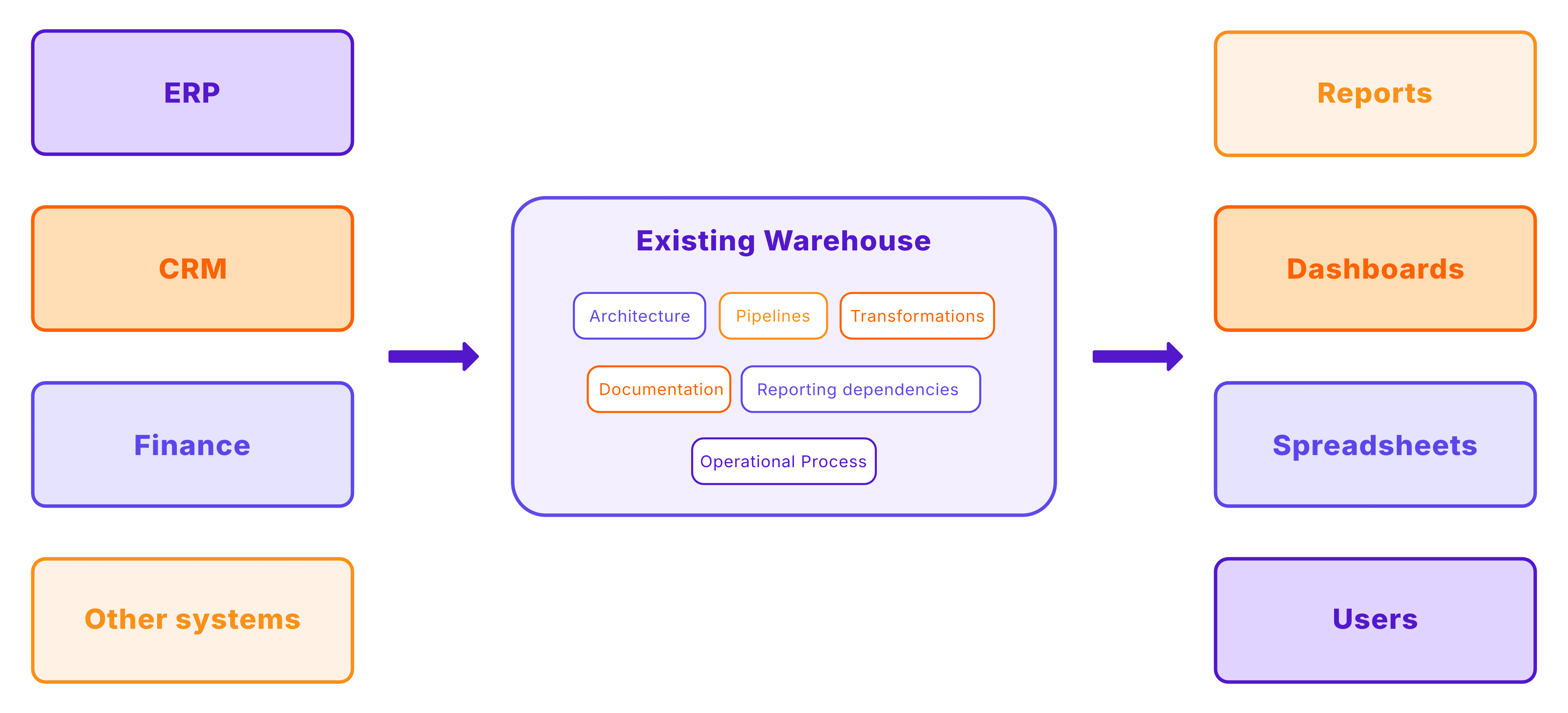
The six areas we look at
Architecture
How your warehouse is structured, how components interact and whether the architecture still fits the business.
How your warehouse is structured, how components interact and whether the architecture still fits the business.
Data flows and pipelines
Where data comes from, how it moves through the environment and where failures, delays or manual intervention occur.
Where data comes from, how it moves through the environment and where failures, delays or manual intervention occur.
Transformations and business logic
Accumulated SQL, scripts and transformation logic, and whether the underlying business rules remain clear and maintainable.
Accumulated SQL, scripts and transformation logic, and whether the underlying business rules remain clear and maintainable.
Reporting dependencies
How dashboards, reports, spreadsheets and downstream processes depend on the warehouse.
Documentation and ownership
Knowledge gaps, undocumented processes and key-person dependencies that create operational risk.
Cost and effort
Looking beyond infrastructure and licensing to understand the broader maintenance and operational burden.
Reporting dependencies
How dashboards, reports, spreadsheets and downstream processes depend on the warehouse.
Documentation and ownership
Knowledge gaps, undocumented processes and key-person dependencies that create operational risk.
Cost and effort
Looking beyond infrastructure and licensing to understand the broader maintenance and operational burden.
Transformations and business logic
Accumulated SQL, scripts and transformation logic, and whether the underlying business rules remain clear and maintainable.
Reporting dependencies
How dashboards, reports, spreadsheets and downstream processes depend on the warehouse.
Documentation and ownership
Knowledge gaps, undocumented processes and key-person dependencies that create operational risk.
Cost and effort
Looking beyond infrastructure and licensing to understand the broader maintenance and operational burden.
Clarity before commitment.
Clarity before commitment.
A maadi architecture review is designed to help you understand why your warehouse has become difficult to maintain and/or where business value can be extracted, as well as what options are realistically available.
The result is a clearer basis for deciding whether to optimise the current environment, augment it with additional capabilities, move to a managed model or plan a rebuild.
A maadi architecture review is designed to help you understand why your warehouse has become difficult to maintain and/or where business value can be extracted, as well as what options are realistically available.
The result is a clearer basis for deciding whether to optimise the current environment, augment it with additional capabilities, move to a managed model or plan a rebuild.
What's working
What's creating friction
Where maintenance effort is going
Where costs are accumulating
Where data quality or trust is breaking down
Where manual processes remain
Where key-person dependencies exist
What can be retained
What should be improved
What should be replaced
Whether augmentation makes sense
Whether rebuilding is justified
An existing warehouse needs more than another technology
recommendation.
Before deciding that the answer lies in another tech solution, you need to understand the architecture, data, and reporting requirements as well as the operational realities around those.
That's why maadi brings data, analytics, reporting, automation and ongoing operational expertise together. We focus the conversation on what the business needs the environment to achieve, rather than starting with a predetermined technology stack.
With maadi we help you find the right answer and the right solution but the starting point is always the same:
Understand what you have before deciding what you need.
An existing warehouse needs more than another technology
recommendation.
Before deciding that the answer lies in another tech solution, you need to understand the architecture, data, and reporting requirements as well as the operational realities around those.
That's why maadi brings data, analytics, reporting, automation and ongoing operational expertise together. We focus the conversation on what the business needs the environment to achieve, rather than starting with a predetermined technology stack.
With maadi we help you find the right answer and the right solution but the starting point is always the same:
Understand what you have before deciding what you need.
An existing warehouse needs more than another technology
recommendation.
Before deciding that the answer lies in another tech solution, you need to understand the architecture, data, and reporting requirements as well as the operational realities around those.
That's why maadi brings data, analytics, reporting, automation and ongoing operational expertise together. We focus the conversation on what the business needs the environment to achieve, rather than starting with a predetermined technology stack.
With maadi we help you find the right answer and the right solution but the starting point is always the same:
Understand what you have before deciding what you need.

Questions, answered plainly.
How do I know if my data warehouse needs optimisation?
Is it better to optimise an existing data warehouse or rebuild it?
How can I reduce data warehouse maintenance costs?
Why do people still use spreadsheets when we have a data warehouse?
Can an existing data warehouse be automated?
What is involved in a data warehouse architecture review?
Don't wait until your next change request to find out what your warehouse costs.
Don't wait until your next change request to find out what your warehouse costs.
Don't wait until your next change request to find out what your warehouse costs.
Understand the cost of what you already own - and whether your data foundation is built to remain economical as your business changes.
Review your current architecture with the maadi team and identify where you can reduce the cost of building, running and changing your data foundation.
Understand the cost of what you already own - and whether your data foundation is built to remain economical as your business changes.
Review your current architecture with the maadi team and identify where you can reduce the cost of building, running and changing your data foundation.
No obligation. Just a clearer view of your data warehouse economics.
No obligation. Just a clearer view of your data warehouse economics.
No obligation. Just a clearer view of your data warehouse economics.